🐸 Golden dart frog
📊Overview
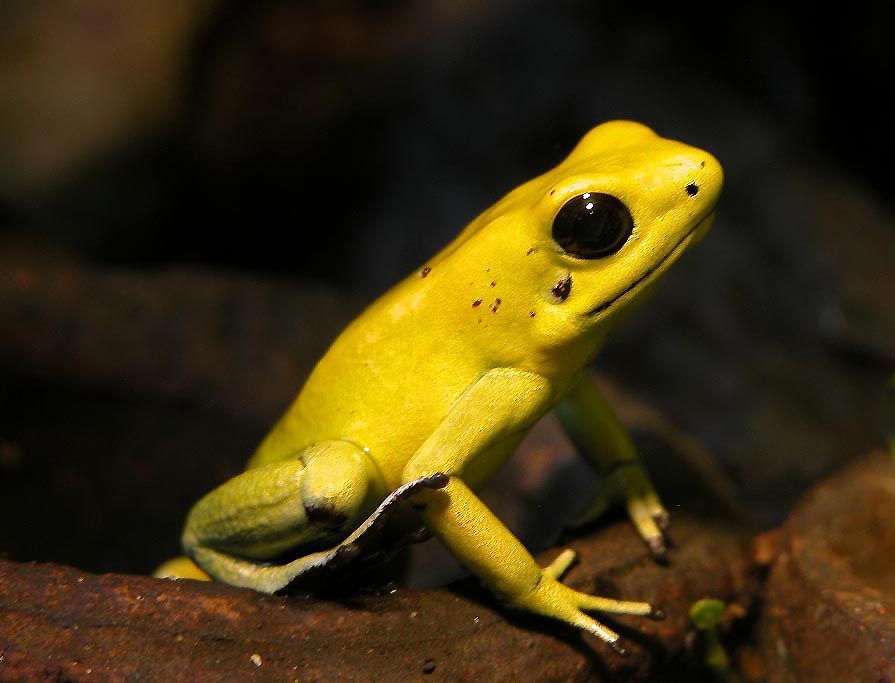
The largest and one of the boldest dart frogs; wild individuals are among the most toxic animals on Earth, but captive-bred frogs raised without their native diet are effectively non-toxic. They are hardy and constantly on display, yet their reputation and permeable skin mean they stay strictly hands-off.
⚡Ownership snapshot
👍 Pros
- Largest, most spectacular dart frog — a true centerpiece
- Bold, diurnal and social; does well in groups
- Captive-bred individuals are non-toxic and safe
- Long-lived, often well past a decade
👎 Cons
- Absolutely not a handling pet; wild-fed frogs are deadly
- Needs more space and a pricier setup than small darts
- Constant supply of cultured live feeders required
- Sensitive to heat, humidity swings and water quality
🧭Temperament & needs
🧠Personality & temperament
The golden dart frog is the largest, boldest and most iconic of all poison frogs — a brilliant, unafraid animal that sits and forages in full view rather than hiding. It is remarkably social for a dart frog, often thriving in communal groups, and makes a spectacular centerpiece display. It offers no affection or interaction; its appeal is purely as a stunning, active living exhibit.
📜Origin & background
Phyllobates terribilis is endemic to a small strip of humid Pacific-coast rainforest in the Chocó region of southwestern Colombia. It lives on the rainforest floor in warm, wet lowland habitat.
🏃Exercise & enrichment
Highly active and ground-dwelling, it roams a large floor area foraging and patrolling, using leaf litter, cork bark and low structures for cover and the occasional climb. Because it is a big, energetic frog, it needs more floor space than smaller darts and stays busy hunting scattered live prey.
✂️Grooming & hygiene
Maintenance is enclosure care: daily misting, spot-cleaning of waste and mold, and a robust springtail/isopod cleanup crew in a bioactive vivarium. Skin is shed and eaten on its own, so there is no molt intervention — just clean, stable, dechlorinated, well-ventilated conditions.
🍽️Diet & feeding
As a large species it takes bigger prey: supplement-dusted flightless fruit flies (especially hydei), plus crickets, bean beetles, isopods and other small feeders. Feed adults every one to two days and growing froglets daily, dusting every feeding with calcium and vitamin-A/D3 to sustain its size and health.
🏠Housing & environment
Give a group a bioactive, planted vivarium of at least 18-29 gallons (more for a colony), with a drainage layer, ABG-type substrate, deep leaf litter, live plants and plenty of ground cover. Keep temperatures around 22-27°C (72-80°F), never sustained above ~28°C, with 80-100% humidity from misting under a sealed lid. Provide a shallow water area and use RO or dechlorinated water only.
🩺Health & lifespan
Overheating is the most dangerous risk — these lowland frogs still fail above the high-20s°C. Watch for nutritional disease (spindly-leg, short-tongue, metabolic bone disease) from poor supplementation, plus chytrid, bacterial infection, obesity and bloat/edema, and keep water free of chlorine. With good care it lives 10-20 years or more.
🎓Training & socialization
This is strictly a display animal — do not handle it casually; its permeable skin absorbs residues, and while captive-bred frogs are non-toxic, wild or wild-fed individuals can be extremely dangerous. Move it only when necessary using clean, wet gloves, and simply give new frogs time to settle and feed before considering them established.
💰Cost of ownership
Costs run higher than for smaller darts: a larger bioactive vivarium with lighting, misting and cleanup crew, plus captive-bred terribilis, which command premium prices. Ongoing expenses include steady fruit fly and feeder cultures, supplements, RO/dechlorinated water and electricity for lights and misting.
💚Who it's good for
Confident keepers who want the biggest, boldest dart frog as a hands-off showpiece.
❓Frequently asked questions
Is it dangerous to keep the golden dart frog?
Wild frogs are among the most toxic animals on Earth, but captive-bred terribilis raised without their wild alkaloid-rich diet are non-toxic and safe; still avoid handling and always wash your hands, and never keep wild-caught stock.
How big does it get?
It is the largest poison dart frog, reaching about 4.5-5.5 cm (up to ~2 inches), noticeably bigger and bulkier than most other dart species.
Can I house juveniles with adults?
Terribilis is communal and tolerant, but size-match your group — very small froglets can be outcompeted for food by much larger adults, so raise tiny frogs separately until they bulk up.
🔎People also ask
Similar pets



Similar pets from other species


Sources: American Kennel Club / breed standards · The Cat Fanciers' Association · PDSA / RSPCA pet care guides · Spruce Pets care references