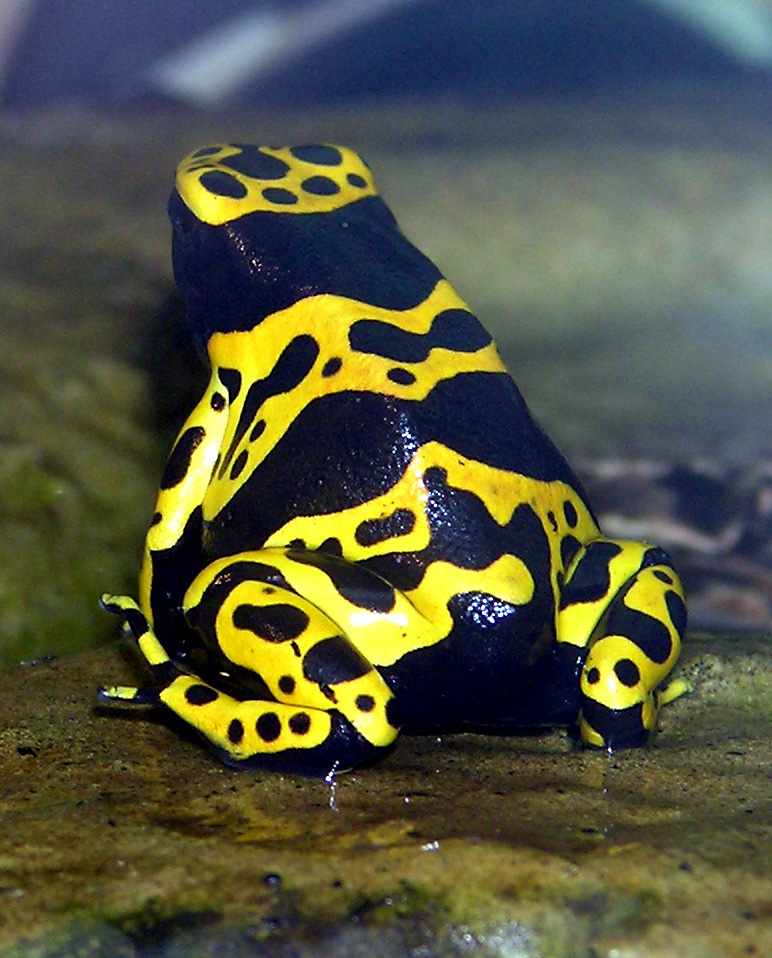
🐸 Green and black dart frog

📊Overview
A hardy, forgiving beginner species that adapts well to a planted tank, though it is shyer and hides more than flashier tincs. It is best treated as a display animal, since its delicate skin means it cannot be handled and males give a soft buzzing call.
⚡Ownership snapshot
👍 Pros
- Hardy and forgiving — one of the best beginner dart frogs
- More tolerant of group housing than most darts
- Non-toxic when captive-bred and very long-lived
- Quiet, odorless, and compact
👎 Cons
- Somewhat shy — needs dense cover to stay visible
- Cannot be handled at all
- Demands consistent high humidity and cool-warm temperatures
- Startup vivarium cost outweighs the price of the frog
🧭Temperament & needs
📈Compared with other Poison dart frogs
🧠Personality & temperament
The green and black dart frog is one of the most popular beginner-friendly darts — active and visible during the day, but a touch shyer and more retiring than the bolder dyeing dart frog, so it appreciates plenty of cover to dart between. Kept in a well-planted group it becomes noticeably more confident and entertaining, with males giving a quiet, buzzing trill. It's a peaceful, rewarding species to observe, though like all darts it is strictly a hands-off pet.
📜Origin & background
Dendrobates auratus ranges through the rainforests of Central America from Nicaragua and Costa Rica down through Panama into northwestern Colombia. It was also famously introduced to the Hawaiian island of Oahu in 1932, where a feral population still persists today.
🏃Exercise & enrichment
This is an agile forager that uses both the ground and low climbing surfaces, so it benefits from dense leaf litter, cork branches, and broad-leaved plants to move through. Scatter-feeding small live prey among the litter is the best enrichment, letting the frog work for its food the way it would in the wild.
✂️Grooming & hygiene
Upkeep means maintaining the vivarium rather than the animal: daily misting for humidity, occasional glass wiping, plant trimming, and a springtail/isopod cleanup crew to process waste. Skin shedding is frequent and self-managed — the frog eats its own shed — so no molt intervention is needed beyond keeping humidity high.
🍽️Diet & feeding
The staple is dusted flightless fruit flies (both melanogaster and hydei), rounded out with springtails, and occasional pinhead crickets or bean beetles. Adults are fed every one to two days and froglets daily, with calcium/D3 and multivitamin supplementation on the prey at nearly every feeding.
🏠Housing & environment
A bioactive vivarium of at least 18×18×18 inches works for a small group, with more space for larger groups since this species is relatively social. Include a drainage layer, ABG-type substrate, deep leaf litter, abundant live plants and hides, and a shallow water area, all seeded with a cleanup crew. Hold humidity at 80–100% and temperatures at 72–80°F (22–27°C), never letting it exceed the mid-80s°F.
🩺Health & lifespan
Captive-bred green and black darts are non-toxic — their wild alkaloid toxins come from a specialized invertebrate diet they don't get in captivity — but their permeable skin still means they should not be handled. Watch for the usual dart-frog concerns: dehydration and overheating from poor climate control, chytrid fungus, metabolic bone disease from inadequate supplementation, bloat, and internal parasites. With good husbandry they commonly live 8–15 years.
🎓Training & socialization
There is no training and no real handling; interaction is limited to feeding, observing, and the rare necessary move done by gentle herding rather than grabbing. Acclimating a new frog is simply about a densely planted, cover-rich enclosure and patience while this slightly timid species learns the tank is safe.
💰Cost of ownership
The frog is inexpensive and one of the more budget-accessible darts, but the setup — bioactive vivarium, misting, lighting, cleanup crew, and supplements — is the main expense. Running costs stay low: mostly home-cultured fruit flies, supplements, and modest electricity for lights and misting.
💚Who it's good for
First-time dart frog keepers who don't mind a shyer, hide-loving species.
❓Frequently asked questions
Is Dendrobates auratus a good choice for a first dart frog?
Yes — it's widely regarded as one of the best beginner species. It's hardy, adaptable, relatively forgiving of minor husbandry mistakes, and tolerant of group living, making it easier than more territorial darts.
Why does my green and black frog keep hiding?
This species is naturally more secretive than boldly out-in-the-open darts. Add more dense planting, leaf litter, and hides so it feels secure; keeping it in a small group also greatly boosts its confidence and daytime visibility.
How many can I keep together?
Auratus is one of the more social darts and does well in groups of three or more, provided the vivarium is large and well-planted so each frog has space. Watch for any bullying and separate persistently harassed individuals.
🔎People also ask
Similar pets



Similar pets from other species


Sources: American Kennel Club / breed standards · The Cat Fanciers' Association · PDSA / RSPCA pet care guides · Spruce Pets care references