🐜 Camponotus (carpenter ants)

📊Overview
Camponotus are the 'giants' of the hobby — large, handsome workers and big majors make a colony easy to watch, and housed in a formicarium they will not tunnel through your house walls the way wild ones do in rotten wood. The catch is patience: colonies grow slowly (often a year or more to reach a few hundred workers), most temperate species require a winter hibernation, and disturbed workers can pinch and spray irritating formic acid.
⚡Ownership snapshot
👍 Pros
- A living superorganism — years of watching a colony grow
- Exceptionally long-lived queen (often well over a decade)
- Low ongoing food cost and cheap to start
- Cannot sting; safe and fascinating to observe
👎 Cons
- Grows slowly — needs patience over months to years
- Escape-prone; demands a reliable barrier
- Temperate species need a cool winter diapause
- Non-native species may be illegal or ecologically risky to keep/release
🧭Temperament & needs
📈Compared with other Pet ants
🧠Personality & temperament
Keeping Camponotus is keeping a superorganism — you watch a single large queen slowly build a colony of hundreds of polymorphic workers, from tiny minors to big-headed majors. They are calm, methodical, and endlessly watchable as they tend brood, forage, and excavate, but the appeal is the colony as a whole rather than any individual ant. Patience is essential: colonies grow slowly and reward long-term observation.
📜Origin & background
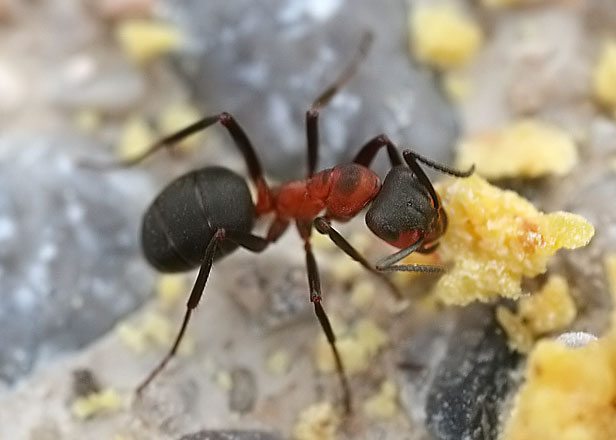
Camponotus is one of the largest and most widespread ant genera, with over a thousand species found on nearly every continent, from temperate woodlands to tropical forests. Known as carpenter ants, many nest inside dead or damp wood in the wild, though in captivity they thrive in artificial nests.
🏃Exercise & enrichment
Foraging is the enrichment — an attached 'outworld' arena lets workers roam, hunt feeder insects, and haul food back to the nest. Scatter food, add cork bark and stones, and let them explore; a busy foraging trail is a sign of a healthy, thriving colony.
✂️Grooming & hygiene
The ants keep themselves and their nest immaculate, piling refuse in a midden that you simply remove from the outworld every few days. Wipe down the foraging arena, refresh the water source, and keep any escape barrier (fluon or talc) clean and intact.
🍽️Diet & feeding
Offer a constant sugar source — sugar or honey water, or a commercial ant nectar — for the workers' energy, plus protein several times a week as freshly killed insects (roaches, mealworms, crickets) for the queen and growing brood. Remove uneaten insects promptly before they mold.
🏠Housing & environment
New queens are founded in a simple test-tube setup with a cotton-plugged water reservoir; established colonies move into a formicarium (aerated concrete/Ytong, acrylic, or 3D-printed) connected to an outworld foraging arena. Provide gentle heat at one end (around 24-26C / 75-79F) and a humidity gradient — one damp region and one dry — and coat the outworld walls with a PTFE/fluon or talc barrier to stop escapes. Keep the whole setup out of direct sun so the colony is never cooked.
🩺Health & lifespan
Most losses happen at the founding stage — mold in the test tube, dehydration, or a queen disturbed too often will doom a young colony, so resist the urge to keep checking on them. Temperate Camponotus also require a cool winter diapause (roughly 10-15C for a few months); skipping it stresses the colony and can shorten the queen's otherwise remarkable lifespan. Overheating, mite infestations, and drying out are the other common killers.
🎓Training & socialization
Ants are not handled or tamed — interaction means observing and feeding, not touching. Camponotus cannot sting, but disturbed workers will bite and can spray formic acid, so keep hands out of the nest and arena.
💰Cost of ownership
A founding test tube costs almost nothing, but a proper formicarium, outworld, heating, and escape barrier are a moderate up-front outlay that grows as the colony needs bigger housing. Ongoing costs are low — sugar, a few feeder insects, and the occasional nest upgrade.
💚Who it's good for
Keepers who want big, impressive ants and don't mind waiting years for the colony to mature.
❓Frequently asked questions
How long until my colony has hundreds of ants?
Expect the first workers (nanitics) within a couple of months of the queen laying, then slow growth in year one. Camponotus are notoriously slow starters and may take two to three years to reach the hundreds.
Do I really need to hibernate them?
Temperate Camponotus need a winter diapause at around 10-15C for two to three months — it is natural, improves brood health, and contributes to the queen's long lifespan. Tropical species do not require it.
Will they damage my house like wild carpenter ants?
No. A captive colony lives inside the formicarium and cannot chew through it; they only excavate soft or damp wood, and a sealed, barriered setup keeps them fully contained.
🔎People also ask
Similar pets


Similar pets from other species


Sources: American Kennel Club / breed standards · The Cat Fanciers' Association · PDSA / RSPCA pet care guides · Spruce Pets care references