🐜 Lasius niger (black garden ant)

📊Overview
Lasius niger, the common black garden ant, is the classic starter species — cheap, tough, forgiving of mistakes, and headed by a fully claustral queen that can live an astonishing 15–28 years. The main caveats are that the tiny workers are expert escapers through the smallest gap, and temperate colonies genuinely need a cool winter hibernation rather than year-round warmth.
⚡Ownership snapshot
👍 Pros
- Extremely cheap to start and maintain
- Very hardy and beginner-forgiving
- Fascinating colony behavior to watch
- Exceptionally long-lived queen
👎 Cons
- You watch them, you cannot handle them
- Meticulous escape-proofing is essential
- Needs an annual winter cool-down (diapause)
- Slow, patient progress in the founding year
🧭Temperament & needs
📈Compared with other Pet ants
🧠Personality & temperament
A famously beginner-friendly ant and the classic "first colony" for a reason. You mostly watch rather than interact, and the fascination is in observing brood care, foraging trails, and a single queen slowly building into a colony of thousands over years. They are calm, tolerant of beginner mistakes, and quietly hypnotic through glass.
📜Origin & background
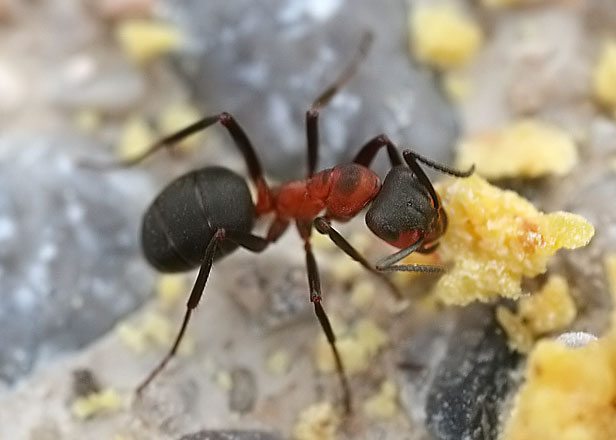
Lasius niger is the common black garden ant of Europe and temperate Asia, nesting under paving, in lawns, and beneath stones. It is one of the most abundant and best-studied ants across its range.
🏃Exercise & enrichment
Activity here means foraging and nest work, so attach an "outworld" (foraging arena) to the nest where workers can hunt, explore, and haul food back. Scatter-feeding and offering varied insect prey keep the colony engaged and mimic natural foraging.
✂️Grooming & hygiene
Ants self-clean, so your job is enclosure hygiene: remove the colony's refuse pile (midden) of husks and dead workers, wipe down the outworld, and keep the hydration source topped up. Maintain the nest's humidity gradient and stop mold before it starts, especially around spilled sugar water.
🍽️Diet & feeding
Give a carbohydrate source (sugar water, honey, or ant nectar) more or less constantly, plus small protein items like fruit flies, roaches, or mealworm pieces two to three times a week. Protein demand rises sharply when the queen is laying and larvae are growing.
🏠Housing & environment
Start a founding queen in a test-tube setup (water plugged behind cotton) and only move her to a formicarium once she has roughly 20 or more workers. A ytong, acrylic, or plaster nest with a hydration port, connected to a small outworld with an escape barrier of fluon/PTFE or talc, suits them well. Room temperature is fine, though a gentle heat cable on one end (around 24-26°C) speeds growth, and offering both a humid and a dry chamber lets them position brood as they like.
🩺Health & lifespan
Most losses are keeper-caused: dehydration, mold from overfeeding protein, escaped or drowned workers, and chilling. Founding queens must be left undisturbed in the dark, and repeated "just checking" is a leading cause of failed colonies. With good humidity and an annual winter cool-down (diapause), a queen commonly lives well over a decade, with exceptional individuals reaching their late 20s.
🎓Training & socialization
These are strictly for observing, not handling, and picking at them stresses the colony and can provoke defensive bites. "Acclimation" simply means giving a new queen darkness and several weeks of undisturbed quiet to raise her first workers.
💰Cost of ownership
Startup is very low: a queen is inexpensive or even free if you catch one after a nuptial flight, and a test tube plus a basic nest and outworld is modest. Ongoing costs are trivial, just a little sugar and some feeder insects, making this one of the cheapest pets to keep.
💚Who it's good for
Absolute beginners and children who want a low-cost, near-indestructible first colony.
❓Frequently asked questions
Do I need to feed the queen while she raises her first workers?
No. Lasius niger founds fully claustrally, living off her body reserves and wing muscles, so you just keep her tube hydrated and leave her in the dark until the first tiny workers (nanitics) appear.
Can they sting me?
They have no sting. At most a large colony may bite and dab a little formic acid, which is harmless to people, so they are safe around children.
Why did my colony stop growing in autumn?
Lasius niger naturally enters diapause over winter and brood production pauses. A cool period (roughly 5-15°C) is normal and is actually important for the queen's long-term health.
🔎People also ask
Similar pets


Similar pets from other species


Sources: American Kennel Club / breed standards · The Cat Fanciers' Association · PDSA / RSPCA pet care guides · Spruce Pets care references