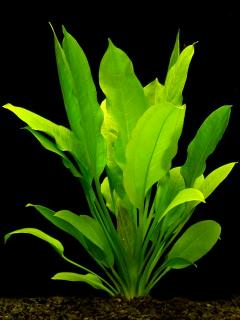
 Photo: Salvatore vitale / Public domain
Amazon Sword Care
Echinodorus grisebachii · Alismataceae
🐾 Pet-safe
🎯 Easy
☀️ Medium, bright indirect
💧 Every 7 days
Photo: Salvatore vitale / Public domainEchinodorus grisebachii · Alismataceae
The Amazon Sword (Echinodorus grisebachii) is an aquatic plant grown submerged in freshwater aquariums. It comes from South America and is rated Easy to keep, reaching 30–50 cm. Here is how to grow it underwater — lighting, substrate, CO₂, placement and propagation.
| Growth rate | Moderate |
|---|---|
| Mature size | 30–50 cm (12–20 in) |
| Native region | South America |
| Plant family | Alismataceae |
| Toxicity | Non-toxic |
| Air-purifying | No |
| Ideal for | beginners, homes with pets, filling a corner |
Keep the water at 22–28 °C. Stable, gently moving water and regular partial water changes keep it healthy; sudden swings in temperature or chemistry cause melting.
Give it Medium, bright indirect-equivalent aquarium lighting. Low-tech tanks suit undemanding species; brighter light (and often CO₂) brings out the best colour and compact growth but also feeds algae, so balance it carefully.
Plant it in a nutrient-rich aquarium substrate (or attached to wood/rock). Rooted species are hungry feeders — use root tabs or a liquid aquarium fertiliser (and CO₂ for demanding types). Epiphytes like Anubias, Java fern and Bucephalandra must NOT be buried: tie or glue their rhizome to wood or rock, or they rot.
Its size and habit suit a spot in the foreground, midground or background depending on how tall it grows; trim and replant tops to keep it dense.
Spring and early summer, during active growth, give the best success. Here is how to do it, step by step:
| Plant type | Aquatic plant |
|---|---|
| Genus | Echinodorus |
| Family | Alismataceae · Alismataceae |
| Native to | South America |
| Symptom | Likely cause | What to do |
|---|---|---|
| Algae on leaves or glass | Too much light or excess nutrients in the water | Cut the lighting period, reduce feeding, and add algae-eating clean-up crew. |
| Melting or dissolving leaves | Shock from a new tank (common when settling in) | Be patient — trim mushy leaves; new submerged growth usually follows. |
| Yellowing leaves | Usually overwatering or poor drainage | Let the soil dry more between waterings and make sure the pot drains. |
The usual indoor pests are spider mites (fine webbing, speckled leaves), mealybugs (white cotton-wool tufts), scale (small brown bumps), and fungus gnats (tiny flies from soggy soil). Inspect any new plant before it joins the others, wipe the leaves now and then, and let the topsoil dry to keep gnats away. At the first sign, isolate the plant, wipe or rinse off what you can, and treat with insecticidal soap or neem oil every week until it is clear.
No — the ASPCA lists the Amazon Sword as non-toxic to cats and dogs. Eating a lot of any plant can still cause mild stomach upset.
About every 7–7 days — let the top few centimetres of soil dry out first, then water thoroughly and drain.
Medium, bright indirect. Keep it out of harsh direct midday sun unless it is a full-sun plant.
Too much light or excess nutrients in the water. Cut the lighting period, reduce feeding, and add algae-eating clean-up crew.
About every 2 years, ideally in spring. Move up just one pot size when the roots fill the pot or creep out of the drainage holes.
It is a Moderate grower, with most of its growth in the brighter, warmer months of spring and summer.
Usually 30–50 cm indoors, depending on light, pot size, and how long you have had it.
It is grown mainly for its looks rather than as an air-purifying plant, though all houseplants add a little greenery and humidity.
It is rated easy. It is very forgiving and great for beginners.
Care values reflect established horticultural guidance; toxicity is cross-referenced with the ASPCA.


Last reviewed: 2026-08-23